Our team has seen on the ground that choosing the right flat roof membrane is the biggest factor in surviving brutal Tucson summers. You probably know the struggle of keeping a building protected when the desert sun beats down every single day. These two single-ply options dominate the market, but treating them as interchangeable is a costly mistake.
We run Tucson Roof Gurus, and owner Kevin Bayes has spent years diagnosing premature membrane failures across southern Arizona. The data shows very different lifespans for these materials under extreme thermal stress. Let’s look at the numbers, examine what they actually mean for your property, and explore practical ways to respond.
Our goal is to break down the exact criteria used to make a recommendation so you can choose the best system. If you are researching TPO vs PVC Roofing in Tucson: Which Flat Roof Membrane Lasts Longer?, you have certainly heard about these materials.
The right choice will save you thousands of dollars in premature replacement costs.
Understanding What TPO and PVC Actually Are
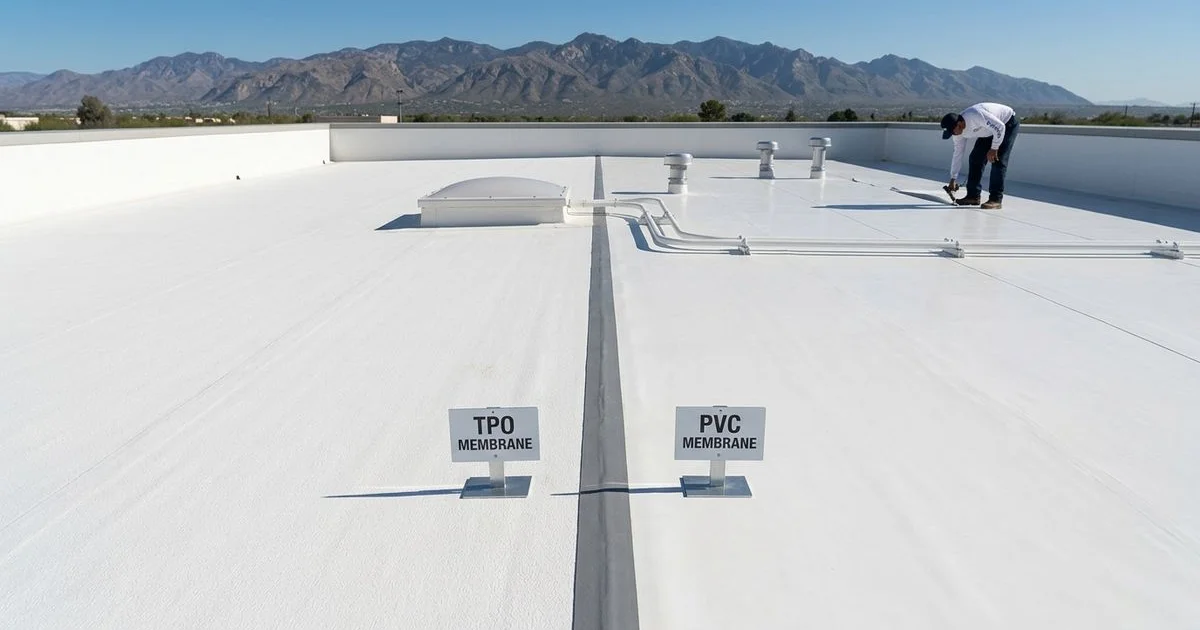
We see a lot of confusion regarding the actual chemical makeup of these membranes. Before exploring the comparison, it helps to understand what you are actually getting with each material. TPO (Thermoplastic Polyolefin) is a single-ply membrane made from a blend of polypropylene and ethylene-propylene rubber.
Our industry data shows the TPO commercial roofing market is booming and projected to reach over 3.8 billion dollars in 2026. This material became popular in the early 2000s as a lower-cost alternative to PVC. Major manufacturers like GAF, Carlisle, and Duro-Last produce these membranes for homes and businesses to meet the stringent ASTM D6878 standard.
We prefer the stability of PVC for long-term projects because of its proven history. PVC (Polyvinyl Chloride) roofing membrane has been around since the 1960s and has a much longer track record. Modern commercial applications typically rely on ASTM D4434 Type III or Type IV PVC, which include strong internal fabric reinforcement.
Our installation crews appreciate that both are white or light-colored, heat-welded at the seams, and offer good reflectivity. The formulation also includes UV stabilizers and other additives designed for long-term outdoor exposure. Key differences in their composition lead to meaningful differences in how they hold up under Tucson conditions:
- Chemical Base: TPO blends rubber and plastic, while PVC uses polyvinyl chloride.
- Flexibility Agents: PVC relies on added plasticizers to stay pliable, whereas TPO is naturally flexible.
- Track Record: PVC has over 60 years of use compared to TPO’s roughly 30 years.
- Market Share: TPO currently accounts for the largest share of the commercial flat roofing market in the United States.
- Thickness Standards: Most local projects require a minimum 60-mil thickness for both materials to survive the desert heat.
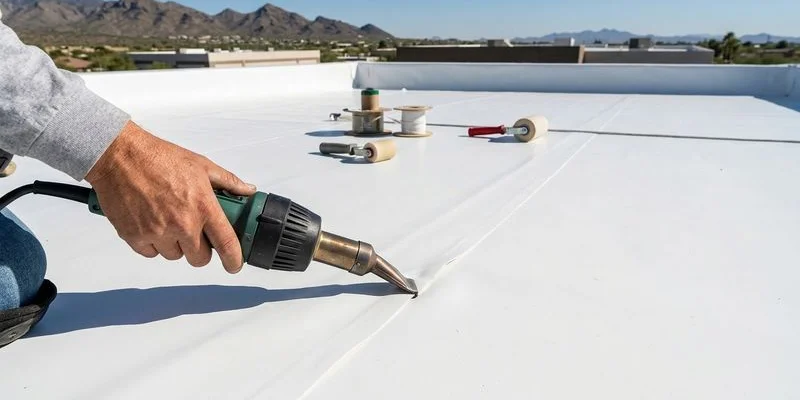
UV Resistance: Where PVC Has a Clear Advantage
We know that PVC roofing has a significant advantage here. Tucson receives over 300 days of sunshine per year, and local weather data shows our UV index regularly hits an extreme level of 11 or higher throughout the summer months. For a flat roof membrane sitting directly under that relentless sun with zero shade, UV resistance is arguably the single most important performance characteristic.
Our team has observed that high-quality PVC membranes maintain their flexibility and structural integrity for 20 to 30 years even under intense UV exposure. The secret lies in additives like titanium dioxide, which acts as a powerful sunscreen to scatter and absorb harmful radiation. The material does not become brittle, and it retains its reflective properties consistently over time.
We have seen that earlier generations of TPO had well-documented problems with UV degradation in high-exposure environments. Manufacturers have improved their formulations considerably, but TPO still has a shorter track record of proven UV performance. TPO’s polyolefin base can sometimes struggle to lock in those UV-blocking additives as effectively as PVC over decades of exposure.
Our technicians have personally replaced several TPO roofs in the Tucson area that failed prematurely due to UV-related embrittlement, some after as few as seven to eight years. This is particularly true in climates as extreme as southern Arizona.
“A UV Index reading of 6 to 7 represents a high health vulnerability, but Tucson regularly blasts roofs with an index of 11 or higher, rapidly accelerating material degradation.”
Heat Performance: Both Handle It, but Differently
We consistently see lower cooling bills for homeowners who upgrade to these reflective systems. Both TPO and PVC are white, reflective membranes that do an excellent job of bouncing solar energy away from the building. In a city where summer roof surface temperatures can exceed 160 degrees, that reflectivity translates directly into energy savings.
Our maintenance records indicate PVC can lose some of its plasticizers over time when exposed to extreme heat. This gradual loss can make the material slightly less flexible as it ages past the two-decade mark. Modern PVC formulations use much more stable plasticizers than older versions to combat this exact issue.
We recommend regular inspections to monitor this natural wear and tear, which typically takes 20 or more years to become noticeable. TPO handles sustained heat reasonably well and does not rely on plasticizers for its flexibility. According to the Cool Roof Rating Council, a bright white single-ply roof can reflect up to 80 percent of the sun’s rays, dramatically reducing the load on your air conditioner.
How Thermal Cycling Affects Seams
Our crews know that a roof surface might go from 80 degrees in the morning to 160 degrees in the afternoon and back down at night. Those thermal cycles stress the weld joints over thousands of repetitions. For most flat roofing applications in Tucson, both materials provide adequate heat performance.
Our experience shows the question of long-term durability under our specific thermal cycling conditions gives PVC a slight edge. The more rigid nature of aged PVC helps the seams resist the constant pushing and pulling caused by extreme temperature swings.
Seam Strength: A Critical Factor for Monsoon Season
We consider seam integrity a major advantage over mechanically fastened or adhesive-based systems. Both TPO and PVC are installed using hot-air welding to fuse the seams together, creating a monolithic, watertight surface. When properly welded at temperatures reaching 900 to 1100 degrees Fahrenheit, both materials produce seams that are as strong as the membrane itself.
Our installers appreciate that PVC material bonds predictably across a wider range of temperatures and conditions. This flexible welding window is highly beneficial during the intense summer heat when equipment temperatures fluctuate. TPO welding requires much more precise temperature control and is highly sensitive to the speed of the machine.
We utilize advanced automatic robotic welders to ensure a perfectly consistent seal on long stretches of roof. A crew that is experienced with TPO will produce excellent welds, but the margin for error is undeniably narrower. Local weather data from 2024 showed monsoon microbursts generating wind gusts over 70 mph in the Tucson Mountains, which severely stresses these exact weak points.
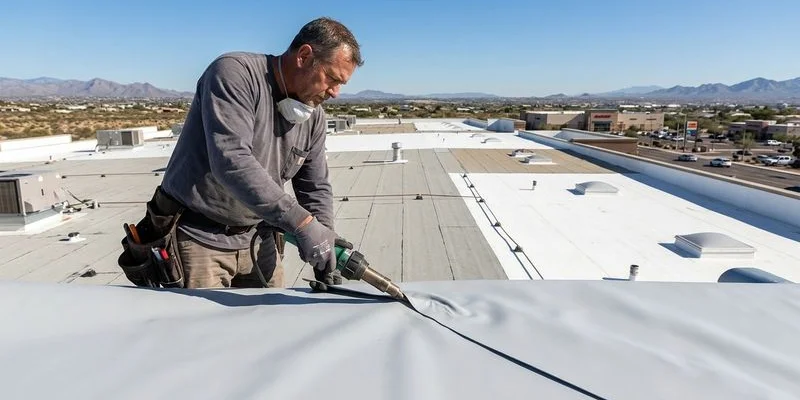
Factors that impact seam welding success include:
- Ambient Temperature: Extreme desert heat changes how the materials melt and bond.
- Welding Speed: TPO requires a very specific pace to avoid scorching the membrane.
- Equipment Calibration: Hot-air welders must be perfectly tuned for the specific material thickness.
- Robotic Assistance: Using automatic welders provides the consistent pressure needed for high peel strength.
Chemical Resistance: PVC Wins for Commercial Applications
We strongly advise against using TPO in environments with heavy grease exposure because it simply cannot match PVC’s inherent defenses. If your flat roof is on a commercial building, PVC is the undisputed winner for chemical resistance. This is particularly true for a restaurant, industrial facility, or any structure where grease, oils, or chemicals might contact the roof surface.
Our teams have repaired numerous TPO roofs that suffered from bubbling, delamination, and severe softening due to grease exposure. In less severe cases, applying roof coatings can extend membrane life, but chemical exposure demands a full PVC system. Rooftop grease exhaust from restaurant kitchen vents is a common issue in Tucson’s commercial districts. The animal fats and cooking oils that settle on the roof surface are absorbed by the polyolefin base of TPO, breaking it down surprisingly quickly.
We always specify PVC for these projects because its chlorinated chemical structure easily handles this exposure without any degradation. For residential flat roofs where heavy chemical exposure is a non-issue, this factor carries much less weight.
“When fatty acids from cooking fats, oils, and grease come in contact with a TPO roofing system, it causes the membrane to soften, delaminate, blister, or crack.”
Our data shows that for commercial property owners, the chemical resistance of PVC is often the deciding factor. TPO’s biggest selling point has always been its budget-friendly price tag. This chemical vulnerability makes TPO a poor choice for food service buildings.
Cost Comparison: Where TPO Has Its Advantage
We frequently install TPO for budget-conscious property owners looking for immediate savings. A TPO flat roof system typically costs less than an equivalent PVC system, including both materials and installation. Based on 2026 industry pricing, TPO installation generally costs between $5.50 and $9.00 per square foot.
Our estimates show that for a large commercial roof, that difference can amount to thousands of dollars in initial savings. In contrast, PVC roofing typically ranges from $7.00 to $12.00 or more per square foot. However, when you factor in the longer proven lifespan of PVC in extreme climates like Tucson’s, the cost-per-year calculation changes drastically.
We always run these long-term return on investment calculations for our clients to clarify the real costs. A PVC roof that lasts 25 to 30 years costs significantly less per year than a TPO roof that requires replacement after 15 to 20 years. Manufacturers offer up to 20-year No Dollar Limit warranties for both materials, but PVC has a higher likelihood of outlasting that coverage locally.
Long-Term Value Assessment
Our financial breakdown helps clients see past the initial sticker shock of a premium system. For building owners who are planning to hold their property for a decade or more, PVC is generally the better long-term investment in this market. For owners who need to minimize upfront costs or are planning to sell within a few years, TPO provides solid performance at a lower initial price point.
| Roofing Material | Estimated 2026 Cost (Per Sq. Ft.) | Expected Lifespan in Tucson | Best Use Case |
|---|---|---|---|
| TPO | $5.50 - $9.00 | 15 - 20 Years | Budget-conscious projects, short-term property holds. |
| PVC | $7.00 - $12.00+ | 20 - 30 Years | Long-term investments, high chemical exposure areas. |
Our Recommendation for Tucson Properties
We stand by PVC as the general recommendation for most Tucson applications. The right choice depends heavily on your property goals and the specific microclimate of your building. This is especially true when the roof is going to face full sun exposure with no shade from taller structures or parapet walls.
Our team recognizes that the initial cost is higher, but the long-term security is well worth the investment. PVC’s superior UV track record, more forgiving installation characteristics, and longer proven lifespan in desert climates make it the safer choice for this area. Paying a bit more for proven durability is usually the right call in a climate that punishes roofing materials as aggressively as ours does.
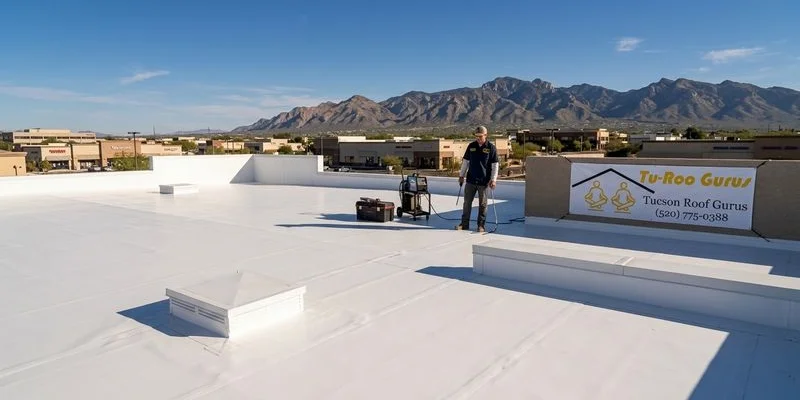
We proudly install TPO if the budget is the primary concern, provided the installation is performed by an experienced crew. The newer TPO formulations perform significantly better than early versions, and a well-installed system will serve you well for 15 or more years. Both options can be paired with thick rigid foam boards to meet the local R-30 insulation building code requirements for commercial roofs.
Making the Final Decision
We factor all of these variables into a customized roofing plan. If you are considering a new flat roof or need to replace an existing one, the best first step is getting a professional assessment of your specific building. Factors like roof size, drainage, existing substrate, and budget all play into the final recommendation.
Key factors to evaluate during an assessment include:
- Current condition of the roof deck and insulation beneath the surface.
- The exact amount of direct, unshaded sunlight the roof receives daily.
- Local wind exposure and potential for monsoon debris strikes.
- Your specific budget and long-term property ownership goals.
The Bottom Line
We find that both TPO and PVC are solid flat roofing options, but they are not equally suited to Tucson’s climate. PVC’s proven UV resistance, consistent weld quality, and chemical defense give it an edge for long-term performance in our area.
TPO offers a lower upfront cost that makes sense for certain budgets. Our advice is to choose an experienced flat roofing contractor who knows the material they are working with. A perfectly installed TPO roof will outperform a poorly installed PVC roof every time.
The right contractor makes all the difference for your building.
We encourage you to reach out today to schedule your consultation and secure a roof that will actually survive the next summer. When deciding between TPO vs PVC Roofing in Tucson: Which Flat Roof Membrane Lasts Longer?, let the data guide your choice.
Your building deserves the best defense available.

Kevin Bayes
Owner, Tucson Roof Gurus
Kevin Bayes has spent over 25 years installing and repairing roofs across southern Arizona.
Free Roofing Estimate
Need help with your roof? Call us for a no-obligation estimate.
(520) 775-0388