We often notice a common pattern across southern Arizona neighborhoods after the first big summer storm hits. Many homeowners suddenly discover that their cost-effective desert architecture comes with unique maintenance challenges, leading them to search for the 4 Common Flat Roof Problems in Tucson and How to Fix Them.
Our team at Tucson Roof Gurus, led by owner Kevin Bayes, has spent years solving these exact structural headaches.
You probably know that catching warning signs early makes fixes significantly less expensive. The goal is to share the exact repair protocols our crews use every day so you can protect your property.
1. Ponding Water
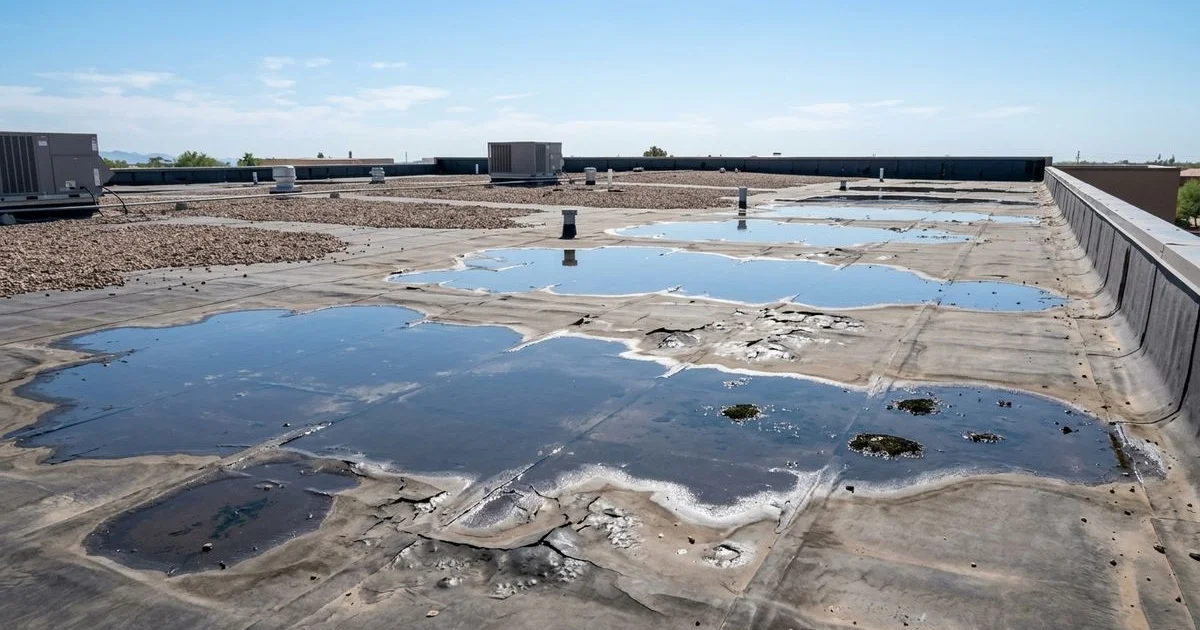
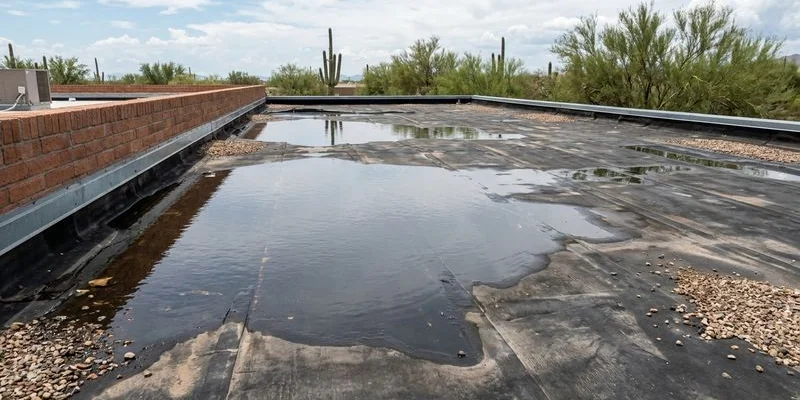
We rank ponding water as the most frequent issue encountered on local properties. A flat roof is never truly flat. Local Pima County building codes mandate a strict quarter-inch per foot slope to direct water toward drains or scuppers.
This specific drop ensures that water routes off the building immediately. Our crews constantly see water pooling on surfaces lacking this essential angle. You might assume a little standing water is harmless since Tucson averages only about 11 inches of rain annually.
Those inches arrive in concentrated bursts between June and September. A single monsoon storm can easily dump an inch or more in under an hour. That massive volume needs immediate routing off your property before it causes severe damage.
The Hidden Dangers of Standing Water
Several destructive processes begin the moment water pools instead of draining. Standing water destroys flat roofs through three specific mechanisms:
- Structural Strain: Every inch of standing water adds exactly 5.2 pounds of dead weight per square foot to your roof deck.
- Material Breakdown: Continuous moisture rapidly degrades standard acrylic coatings and accelerates the failure of TPO membrane formulations.
- Solar Magnification: Puddles act like a magnifying glass under the Arizona sun to focus intense UV radiation directly onto the roofing material.
We frequently notice that scuppers leak first because they act as the lowest point collecting all that runoff. These drainage points often contain four different building materials that expand at different rates. Clearing debris from these scuppers solves minor ponding issues quickly.
A structural correction becomes necessary for persistent low spots. Contractors can install GAF EnergyGuard tapered rigid EPS insulation during a flat roof replacement to create the proper drainage slope. Crickets or saddles offer a great middle-ground solution to divert water away from known low points on existing roofs.
2. Membrane Blistering and Bubbling
Blisters form when pockets of air or moisture become trapped between the membrane and the underlying substrate. Small bubbles might remain stable for years in cooler regions.
Our extreme desert heat causes these pockets to expand aggressively into what locals call roof sores. Tucson surface temperatures vary wildly based on your material color. White TPO roofs might peak around 120 degrees, while older black modified bitumen roofs easily hit 170 to 190 degrees during summer afternoons.
We observe trapped moisture vaporizing and expanding violently at these extreme temperatures. This upward pressure stretches the membrane into a visible bubble. Hundreds of these daily thermal heat cycles force the blister to grow larger over time.
The Impact of Thermal Cycling
The stretched roofing material never quite returns to its original shape once the sun goes down. We watch the material eventually thin out at its peak and crack to create an active leak.
Poor quality installations frequently lead to this catastrophic bubbling.
| Installation Method | Moisture Trapping Risk | Tucson Longevity Impact |
|---|---|---|
| Roof Layover | High (Seals in old moisture) | Blisters often appear within 2-3 years |
| Complete Tear-Off | Low (Exposes bare decking) | Maximizes full 15-20 year membrane lifespan |
Our team strongly advises a tear-off rather than layover to protect your property. Contractors who skip FLIR infrared thermal imaging moisture scans before applying new material over an old roof guarantee future problems. That trapped water vaporizes and destroys the new investment rapidly.
We find that technicians can sometimes cut, dry, and patch small, uncracked blisters. Multiple large blisters usually point to a systemic moisture failure requiring extensive section replacement. Applying a high-solids silicone roof coating prevents new blisters by creating a seamless, waterproof barrier over the repaired sections.
3. Flashing Failures at Roof Edges and Penetrations
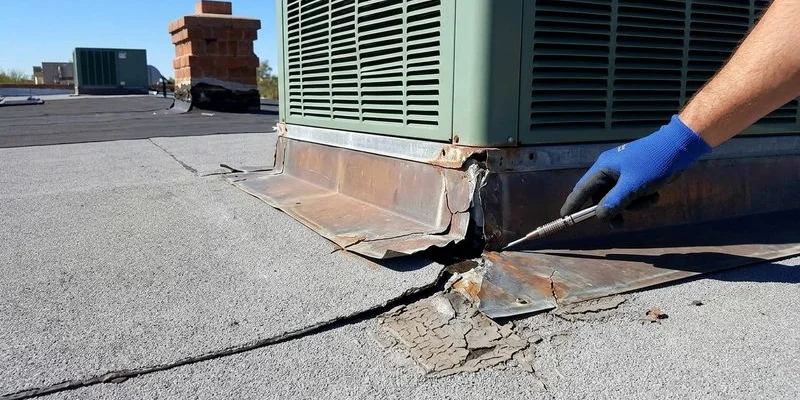
Flashings use metal and membrane pieces to seal the most vulnerable intersections on your building. These critical zones include parapet walls, HVAC units, drain drops, and plumbing vents.
Our local environment subjects these transition points to relentless thermal cycling. Flashing defects represent the single most common source of active interior leaks. Physics dictates exactly why these failures happen on a daily basis.
We see metal flashing components expand in the midday heat and contract rapidly after sunset. A sudden afternoon monsoon rain hitting a 150-degree roof causes violent, immediate material contraction. The adhesives and sealants bonding the metal to the membrane also expand and contract, but at completely different rates.
The HVAC Vibration Factor
Our inspections frequently reveal tiny gaps developing after thousands of these extreme temperature swings. A heavy August storm forces water directly through those newly opened seams.
Rooftop air conditioning units create severe complications for nearby flashings. The heavy machinery vibrates continuously during operation. This constant mechanical shaking compounds the damage caused by thermal stress.
We trace roughly 45 percent of all commercial and residential flat roof leaks directly back to failed HVAC transition seals. Fixing flashing requires matching the solution to the severity of the separation.
- Surface Resealing: A UV-stable polyurethane roof sealant like Geocel or APOC can repair minor caulk joint separations.
- Fabric Reinforcement: Three-course patching uses liquid mastic and reinforcing mesh to bridge moderate gaps.
- Complete Replacement: Corroded or physically warped metal requires full removal and custom fabrication.
Our recommended annual roof maintenance gives professionals the chance to physically probe these specific stress points. Catching a failing seal early prevents water from destroying your interior drywall.
4. UV Degradation and Surface Cracking
Every exposed surface in our region fights a constant battle against ultraviolet radiation. The intense solar energy slowly breaks down the essential chemical bonds inside roofing membranes.
We constantly monitor properties exposed to an extreme UV Index of 11 or higher throughout the summer months. High altitude, clear skies, and roughly 300 days of annual sunshine accelerate this destruction. A standard installation that lasts 20 years in cloudy climates often fails here in just 12 to 15 years.
Our local climate demands specific maintenance strategies based on your material type. Watch for these distinct warning signs:
| Membrane Type | Primary Signs of UV Degradation |
|---|---|
| TPO & PVC | Heavy surface chalking, stiffness, and micro-cracking |
| Modified Bitumen | Granule loss exposing the underlying black asphalt |
| Built-Up (Tar & Gravel) | Bare spots where protective gravel ballast has shifted |
Reflective Coating Solutions
You know the material is reaching the end of its functional life when it loses its smooth texture or starts curling at the seams. We recommend applying a reflective roof coating as the most cost-effective response to early-stage degradation.
A premium 100 percent silicone application, like Henry 887 Tropi-Cool, or products from Tucson Rubberized Coatings can reflect up to 90 percent of solar rays. This targeted upgrade effectively resets the clock and buys an extra 10 to 15 years of waterproof performance.
Our estimators note that preventative coating costs roughly $1.00 to $1.50 per square foot. This price represents a massive savings compared to the heavy cost of a full structural replacement. Inspectors look for widespread, deep cracking as the main indicator that the material requires that full replacement.
Why Proactive Prevention Beats Emergency Repair
Addressing small defects immediately keeps your bank account happy. A minor drainage issue costs a few hundred dollars to fix with simple scupper clearing.
We warn clients that ignoring a puddle leads to rotten roof decking and a five-figure structural reconstruction. The average flat roof repair in Tucson ranges from $300 to $1,500 depending on the damage. A small, fifty-dollar patch on a blister prevents an expensive total membrane failure.
Our experience shows that applying fresh sealant to a flashing gap stops a leak before it ruins your bedroom ceiling and insulation. The smartest prevention strategy involves two professional inspections each year.
- Spring Check (April/May): Prepares the surface for extreme summer heat and clears out winter debris.
- Fall Check (October/November): Assesses any damage caused by monsoon storms and extreme UV exposure.
We make sure qualified technicians physically touch and examine every drain, seam, and transition during these visits. Stopping these problems in their tracks saves massive amounts of money and stress.
4 Common Flat Roof Problems in Tucson and How to Fix Them: Final Thoughts
Proper maintenance ensures these systems perform beautifully in our harsh desert climate. You can stay ahead of expensive water damage by watching for these 4 Common Flat Roof Problems in Tucson and How to Fix Them.
Our crew is ready to help if you own a property in the area and need a thorough assessment.
Please get in touch with our team to schedule a professional evaluation today. The right preventative care adds decades to your roof’s lifespan. We specialize in these unique structures and will give you a completely honest report on exactly what your property needs.

Kevin Bayes
Owner, Tucson Roof Gurus
Kevin Bayes has spent over 25 years installing and repairing roofs across southern Arizona.
Free Roofing Estimate
Need help with your roof? Call us for a no-obligation estimate.
(520) 775-0388